Problem
Every year a large cohort of engineering graduates sits the TCS National Qualifier Test, the gateway to TCS's entry-level hiring tracks. Their job is to pass an exam with a known pattern, on a student budget, often on a phone.
The options fail them: paid coaching behind paywalls, scattered PDFs on messaging groups, and ad-heavy sites with uneven question quality.
The gap: no single free, offline-capable platform combined previous-year questions, structured study material and interactive practice, without sign-ups, ads or paywalls.
Users
Final-year students and recent graduates preparing for the NQT, mostly on mobile and often on unreliable internet.
What I learned came from an informal survey of about 15 aspirants (self-reported), a look at PrepInsta, GeeksforGeeks and IndiaBix on content quality, UX and offline access, and the exam pattern itself: 92 questions across 5 sections (Numerical, Verbal, Reasoning, Programming Logic, Coding) in 150 minutes.
Two findings changed the plan. The top complaints were scattered resources, unverified questions and no way to track progress, so explanations and progress had to be visible features. Most aspirants study on mobile, so offline-first was non-negotiable.
Decision
Trade-offs
Free, with no sign-up. No paywall, no ads, no account; progress lives on the device. The cost: no way to count users or know whether scores moved.
Contributable by freshers. Study content is plain Markdown, and the app has no framework to learn. Adding a question is a data-only change.
What shipped
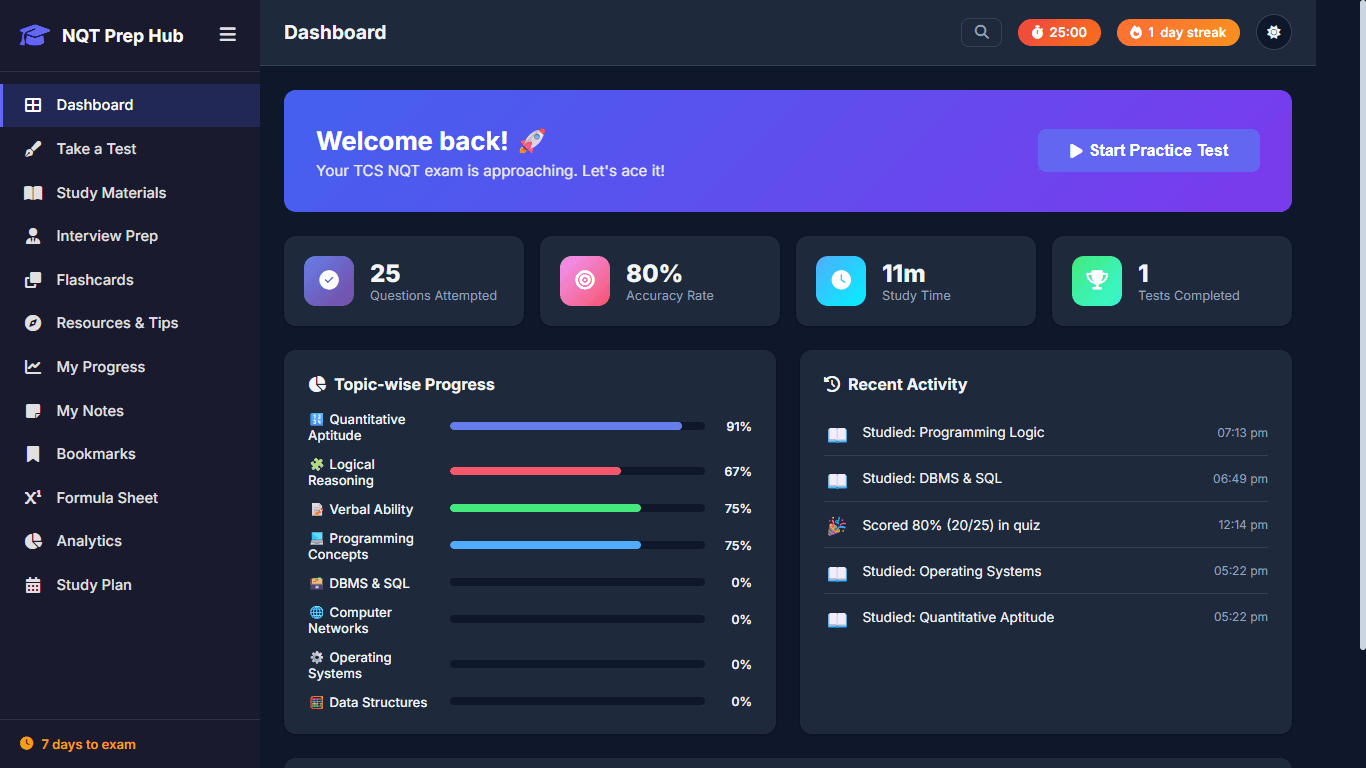
A first-time user on a phone lands on the dashboard shown at the top of this page: progress cards, recent activity and topic-wise mastery. The quiz builder lets them pick topics, count, difficulty and time limit, or take a preset that reproduces the full exam: 92 questions in 150 minutes.
Content volume behind it, per the repo README (the previous-year material builds on @Arjunpolen's question bank): 404 curated practice questions, 10 full previous papers, HR interview prep and a "Know TCS" section.
The rest of the 12 features: flashcards, categorised notes, a Pomodoro timer, bookmarks, dark mode and analytics with topic mastery levels.
Under the hoodArchitecture and implementation
1. Zero dependencies, vanilla JS only. No React, no build tools, no bundlers. The entire app is index.html + app.js + styles.css + data files.
2. Data-driven quiz engine. All questions live in a structured JS data file. The quiz builder filters by topic, difficulty and count at runtime, so adding questions is a data-only change.
// Quiz builder - supports custom configurations
const quizConfig = {
  topics: ['quantitative', 'reasoning', 'verbal', 'programming'],
  questionCount: 25,     // 10 / 25 / 50 / 100
  difficulty: 'mixed',   // easy / medium / hard / mixed
  timeLimit: 30,         // minutes
  mode: 'practice'       // practice (show answers) / test (timed)
};

// Quick-start presets for common patterns
const PRESETS = {
  'Full Mock':    { topics: 'all', count: 92, time: 150 },
  'Quick Quant':  { topics: ['quantitative'], count: 25, time: 30 },
  'Reasoning':    { topics: ['reasoning'], count: 30, time: 40 },
  'Programming':  { topics: ['programming'], count: 10, time: 20 },
};
3. localStorage for persistence, no backend. Quiz scores, flashcard progress, study time, bookmarks and notes persist in localStorage. Users can export and import their progress as JSON for backup or device migration.
Offline. The service worker caches the entire app shell and question bank on first load; once installed, the app works offline.
Validation
The evidence is what a free, no-account product can produce:
- Live: atavisticrystal6888.github.io/TCS-NQT-Prep-Hub returned HTTP 200 on 30 Sep 2026. It is built to install as a PWA, and its service worker caches the app shell and question bank on first load; offline use was not re-tested for this page. The repo README's live badge points to a Pages site under another contributor's account (arjunpolen.github.io, which returned 404 the same day), so this page does not claim sole ownership of the deployment.
- Contributors: GitHub lists four contributor accounts (checked 30 Sep 2026). The commit history shows the other three contributed to the question bank in March and April 2026, before the web app existed; my commits start on 16 May 2026.
- Content volume, not outcomes: 404 questions, 10 papers and 12 features (repo README) describe what was built, not what it changed for anyone.
Limits and next
- No usage data. No sign-ups and no backend means no count of users or quizzes taken; whether scores moved is not measured.
- No licence file. The repository is public but has no licence, so reuse terms are not stated.
- Next bet: find a lightweight, sign-up-free way to learn whether practice moves mock-test scores.
- Open question: how to learn whether scores move without adding the sign-up the product was built to avoid.
Credits
I built the web app. The question bank it serves was started by three other contributors. It began as TCS-NQT-PYQ-QUESTIONS by Arjun (@Arjunpolen), with contributions from @maxprogrammer007 and @Abhishek2003ij; this repository carries that history. I authored 9 of the 17 commits and built the web app on top: the PWA, the quiz engine, the progress analytics and the content restructure.